

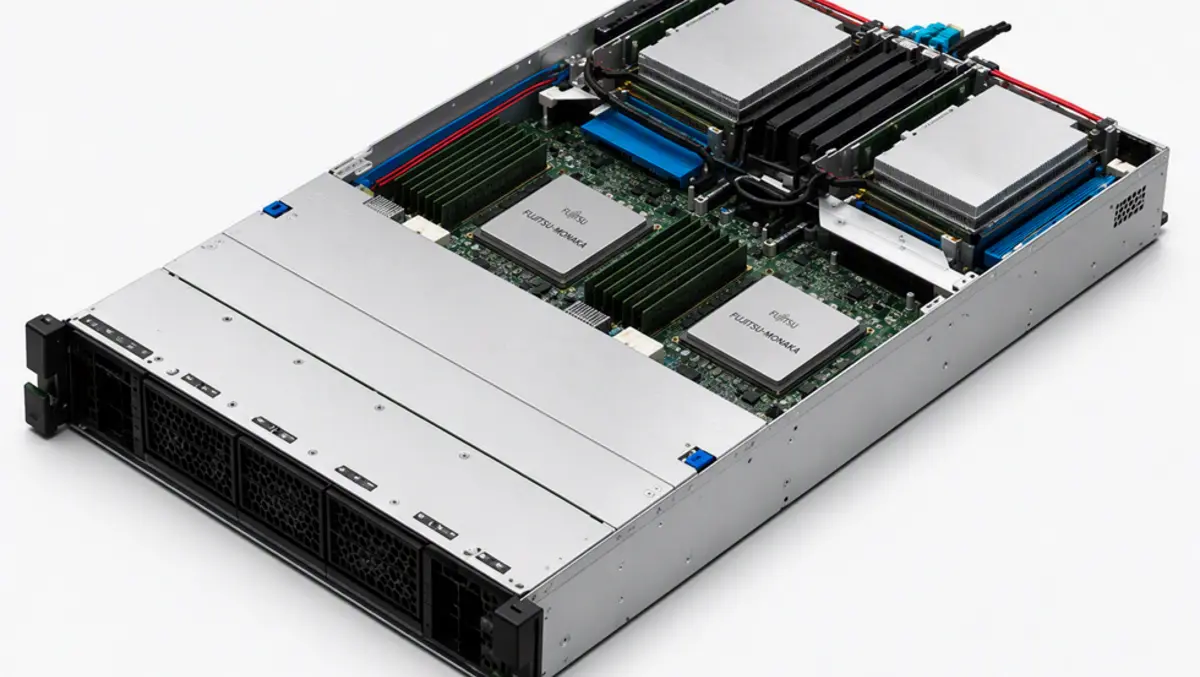

Fujitsu has launched the FUJITSU-MONAKA processor and Fujitsu MONAKA Server for data centres and sovereign AI infrastructure.
The Japanese technology group said the server uses a 2nm processor developed in Japan and will be sold alongside the processor as a standalone product for cloud providers, data centre operators, and server vendors.
According to Fujitsu, the processor delivers twice the AI inference throughput of other central processing units while using half the power for the same workloads. It said organisations could run equivalent workloads with 50% fewer physical servers.
Fujitsu is accepting orders for the standalone processor in Australia and New Zealand, with shipping scheduled to begin on 1 April 2027. The integrated server is due to roll out in Japan and Europe from November 2026, with shipments continuing into 2027.
Data centre focus
The launch comes as operators face pressure to expand AI infrastructure while managing electricity use, cooling demands, and space constraints. Fujitsu is positioning the products primarily for AI inference workloads rather than only traditional high-performance computing tasks.
The processor combines a 2nm process for the core with a 5nm process for cache and input-output functions in a 3D-stacked design, according to the company. It runs at a maximum operating frequency of 3.8GHz and offers memory transfer speeds of 8800MT/s.
The chip includes dedicated instructions for matrix operations used in AI inference and supports confidential computing, which protects data and applications in memory with hardware encryption. Fujitsu said this would support use in secure environments, including multi-tenant cloud settings.
Cooling claims
A central part of the announcement is the server's cooling design. Fujitsu said the 1U server can operate in ambient temperatures of up to 40C using air cooling, allowing deployment in facilities without specialist liquid-cooling systems.
It said this approach could reduce cooling energy consumption by up to 80% and may help data centre operators increase AI capacity without major changes to existing facilities.
Fujitsu said the server line-up would include 2U rack-mount systems with two processors, 1U systems with one or two processors, and 2U multi-node servers with four nodes for academic and high-performance computing uses such as surrogate models and fluid analysis.
Sovereign push
Fujitsu is also linking the launch to demand for sovereign AI systems. It said the MONAKA Server is designed, developed, and manufactured in Japan, with production at its Kasashima plant, and described the domestic supply chain as a way to improve traceability and transparency.
The server is intended for sectors seeking tighter control over infrastructure and data handling, including public institutions, defence, finance, and telecommunications, according to the company. Under the global launch plan, Fujitsu said the server would be made broadly available in Japan and Europe, including for defence applications.
The 1U server also uses CDI and CXL technology to allocate memory and accelerators beyond the physical boundary of a single machine. Fujitsu said this would help address memory shortages in AI inference and allow systems to adapt to larger models and changing workloads.
Mahesh Krishnan, Chief Technology Officer for Oceania at Fujitsu, outlined the regional case for the products.
"AI is taking off across Australia and New Zealand. But rising energy demands are holding local organisations back because traditional GPUs use so much power. Fujitsu-MONAKA is our solution to that challenge. Its ultra-low-voltage design allows you to run AI inference directly on the CPU instead of relying on power-hungry GPUs. This cuts out the massive energy drain, lowering your cost-per watt and letting you run the same workloads with half the physical servers and half the electricity. But the best part is that you don't need to rebuild your data centre with expensive liquid-cooling setups. You can run these servers on standard air cooling in existing facilities, making scaling AI practical, highly secure, and sustainable from day one," said Mahesh Krishnan, Chief Technology Officer for Oceania at Fujitsu.
Beyond hardware, Fujitsu said it plans to build its sovereign AI offering around MONAKA servers, together with its Kozuchi AI platform and Takane generative AI software. It also expects to add high-density AI data centre servers and rack-scale systems with automated maintenance functions to the range.
Fujitsu reported annual revenue of JPY ¥3.5 trillion for its latest fiscal year and said it remains Japan's largest digital services company by market share.