

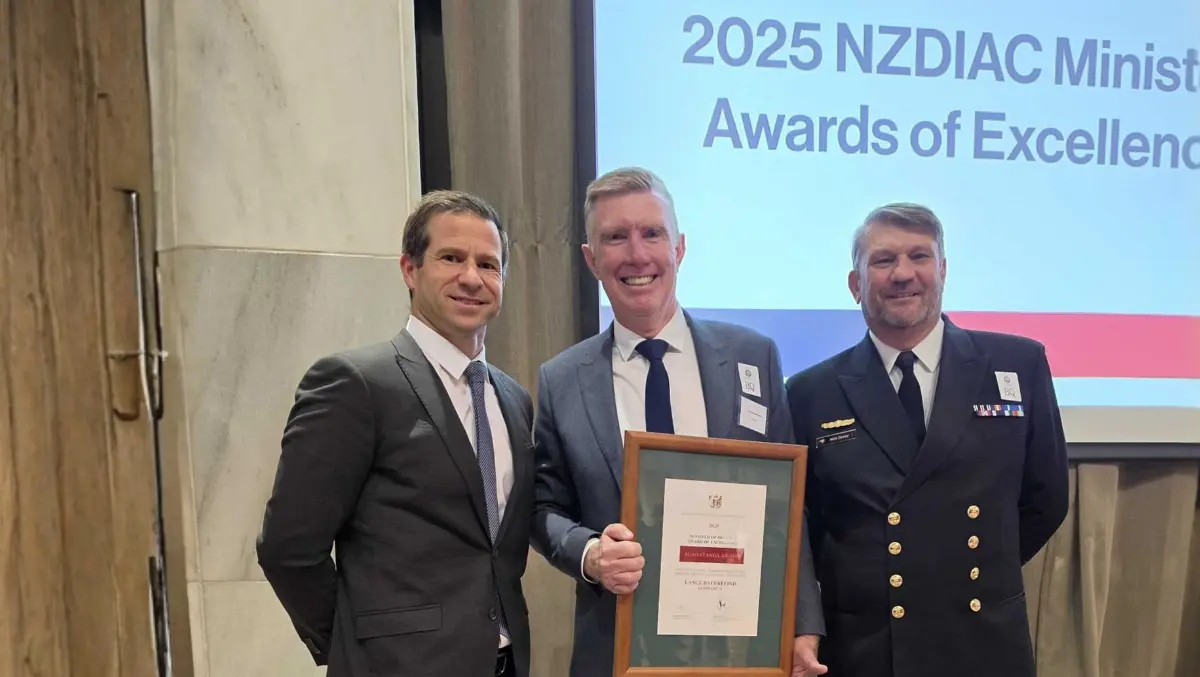

Company-X has won a Defence Ministry innovation award for virtual reality diver training developed for the Royal New Zealand Navy. The award was presented to Lance Bauerfeind, the company's Head of Simulation and Training.
The recognition centres on a multiplayer virtual reality system that allows Navy divers to train in underwater rescue scenarios alongside instructors in the same simulation. It adds a portable virtual training option to the pool and open-water exercises already used by the service.
Bauerfeind received the Auahatanga - Innovation Award at the Minister of Defence Awards of Excellence to Industry. The award recognises an immersive training system the Navy is using to rehearse complex rescue situations in a controlled environment.
The Royal New Zealand Navy described it as the first time it has used virtual reality in a multiplayer format for this kind of training. Instructors can join scenarios in real time with trainees, observe performance directly, and intervene during the exercise rather than waiting until afterwards.
Lieutenant Commander Nick Davey, Programme Manager Maritime Simulation, outlined the safety rationale behind the project. "Navy Divers experience some of the biggest risks within the NZDF and it's our job to reduce those risks as low as reasonably possible," Davey said.
He also highlighted the significance of the format for the Navy's training approach. "This is the first time that we've used virtual reality in a multiplayer environment," Davey said.
Bauerfeind said the system changes how instructors can respond to mistakes during training. "Navy divers operate in some of the highest-risk environments in the NZDF, so having an instructor/trainer alongside you in simulation to immediately course correct your mistakes rather than wait until after the training session is a game-changer. It's another step toward managing safety," he said.
He also pointed to the practical limits of live exercises. "You can't always recreate dangerous or complex scenarios repeatedly in the real world, but people still need to be prepared for them," he said.
Wider uses
The same simulation approach could be adapted for other sectors where staff need repeated training in hazardous, costly, or logistically difficult conditions. Company-X identified emergency response, manufacturing, agriculture, and infrastructure as potential applications.
Co-founder and Director David Hallett said demand for simulation tools is broadening beyond defence. "Simulation technology is becoming increasingly important in environments where organisations need people to train safely, repeatedly and at scale," he said.
He added that the work done for the Navy has wider industry relevance. "The same technologies being used in defence training can also be applied across industries, including emergency response, manufacturing, agriculture, and infrastructure," he said.
The Hamilton-based company has already delivered several immersive training systems for the Royal New Zealand Navy. Among them is a virtual reality flight deck officer training product designed to help personnel practise the procedures, communication, and coordination needed to land helicopters on a frigate.
International push
The award comes after Company-X signed an agreement with Babcock International to take simulation training technology developed in New Zealand to defence customers overseas. The deal reflects an effort by smaller domestic technology firms to use local defence work as a pathway into export markets.
New Zealand's defence awards programme recognises organisations and individuals that support the country's defence sector through service and innovation. In this case, the focus was on a training tool intended to reduce risk for divers working in one of the military's more hazardous roles.
The project also reflects a wider shift in military training towards mixed models that combine live exercises with digital environments. For high-risk tasks, virtual systems can be used to repeat rare or dangerous scenarios more often while keeping instructors close to the action.
For the Navy, the immediate value lies in rehearsing underwater rescues with closer supervision inside the scenario itself. For Company-X, the award is official recognition of a product that has moved from software development into operational training for one of New Zealand's armed services.