

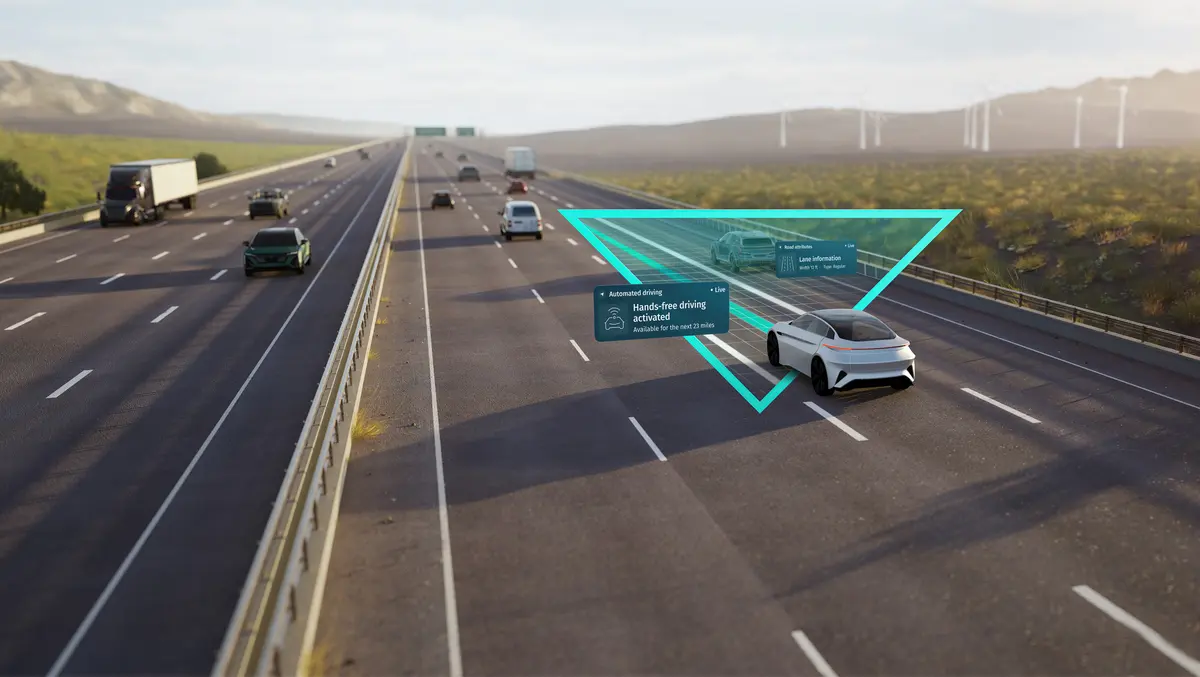

HERE Technologies introduced new Navigation on Autopilot features at Auto China 2026, aimed at supporting Level 2++ automated driving in international markets.
The launch focuses on live map intelligence for automated driving and navigation, including lane-level guidance and a new Predictive Signal Timing service that is still under development. The tools are intended to give vehicle systems and drivers the same road context across countries, road layouts and traffic conditions.
Automakers are under pressure to move assisted and automated driving from test programmes into broader commercial use. That shift has exposed a practical problem: systems trained in one market can behave differently when they encounter unfamiliar road infrastructure, local rules or more complex urban layouts elsewhere.
HERE's approach uses a single road model to align cockpit navigation with automated driving functions. It describes this as a shared source of road information, updated continuously and used from development through on-road operation.
Signal timing
One part of the announcement focuses on intersections, which remain among the most difficult situations for driver-assistance and automated systems. HERE Predictive Signal Timing is designed to combine real-time traffic signal phase and timing data with historic signal patterns and machine-learned traffic behaviour to indicate likely signal changes before a vehicle reaches a junction.
The service remains in development. It is intended to help vehicles anticipate light changes, adjust speed more smoothly, reduce abrupt braking and unnecessary acceleration, and improve energy use and arrival-time estimates.
To support that work, HERE is partnering with Chinese technology companies including Baidu Maps. It presented the collaboration as part of a broader effort to expand the use of its road and traffic data in vehicles produced by Chinese manufacturers for overseas markets.
Lane guidance
HERE also outlined a lane-level guidance system tailored for Navigation on Autopilot use cases. Rather than directing a car along one exact path, the system uses what it calls a route carpet, identifying the lanes a vehicle is most likely to take safely through upcoming lane changes, merges and ramps.
The aim is to give both the driver and the vehicle's automated functions advance awareness of the same manoeuvres. In practice, that should make behaviour easier to predict and narrow the gap between what a driver expects and what the system does.
This has become more important as manufacturers try to offer similar assisted-driving functions across multiple regions. A system that behaves consistently on motorways in Europe, Asia and other markets could reduce the need for separate local versions of the same feature stack.
Lotus project
Alongside the product announcement, HERE said it has worked with Lotus on an overseas integrated navigation and Highway NOA system. The companies described it as a unified cockpit navigation and Highway NOA offering from a Chinese automaker for international markets.
The tie-up reflects a broader industry trend: Chinese carmakers are looking beyond their home market and trying to carry connected and assisted-driving features into global model ranges. That expansion has created demand for mapping and location platforms that can operate across borders without major redesign.
For mapping providers, this has become a strategic opening. Rather than serving only as suppliers of digital maps for in-car navigation, firms such as HERE are trying to embed mapping data more deeply into automated driving systems, where lane position, road geometry, traffic controls and live updates can affect how a vehicle plans and executes actions.
HERE argued that using the same live map data in development, validation and production can help reduce mismatches between training environments and real-world conditions. Continuous updates should also help maintain accuracy as roads change over time.
That matters especially for Navigation on Autopilot systems, where even small differences in lane layout, merge design or intersection control can alter vehicle behaviour. A common road model also offers automakers a way to support international deployment without rebuilding the underlying system for each geography.
"As automated driving moves from validation to real-world delivery, automakers must ensure predictable vehicle performance across diverse road networks, regulations and driving conditions," HERE said.