

.webp)
Zenno has secured a German federal contract to develop autonomous satellite operation software that uses superconducting magnetic technology rather than chemical propulsion for close-proximity manoeuvres.
The contract comes from Germany's Federal Agency for Breakthrough Innovation, also known as SPRIND. The work centres on a project called Autonomous Fuel-Free Agility in Space.
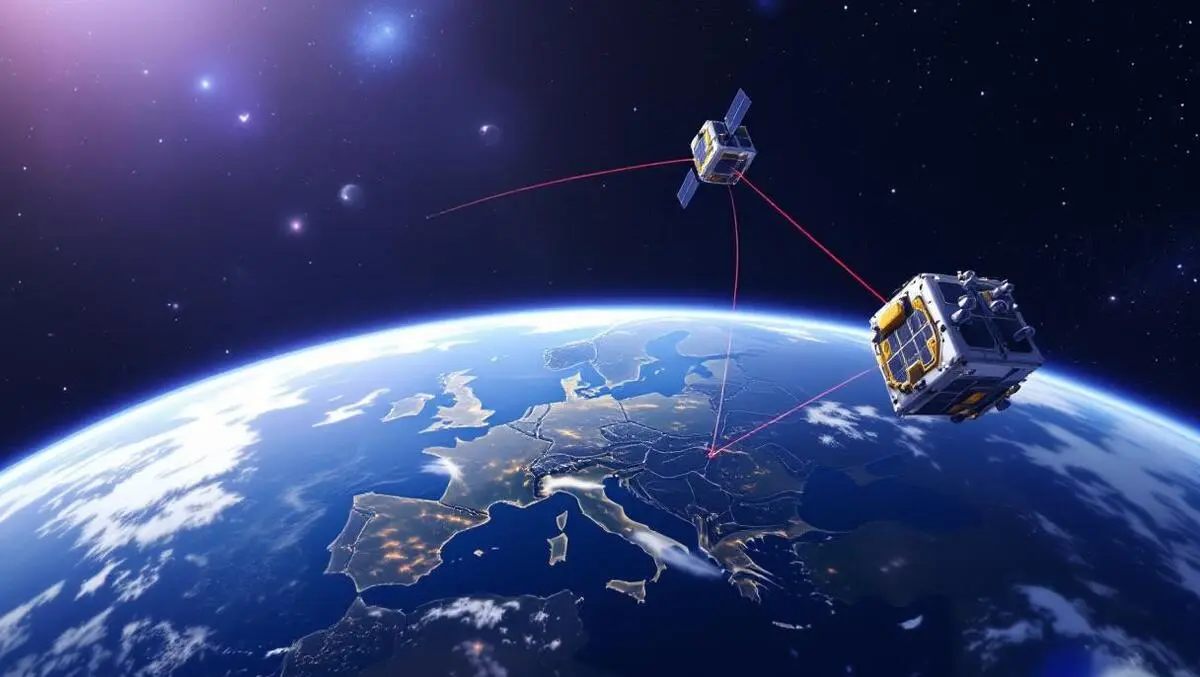
Zenno said the programme will focus on artificial-intelligence-assisted control algorithms and simulation tools for precise operations between satellites flying close together. The company said the aim is to handle tasks such as docking, servicing and in-orbit assembly without using propellant.
Zenno's approach uses a product it calls the Supertorquer. Zenno describes it as a compact superconducting magnetic system. The firm said the system relies on magnetic control rather than fuel-based thrusters for fine movement and alignment during close operations.
"This validation contract from SPRIND is a major step for us," said Max Arshavsky, Co-Founder and CEO, Zenno Astronautics. "It will help bring Zenno technology to Europe and accelerate its adoption in the next generation of autonomous space systems. We look forward to working with SPRIND to push the boundaries of how spacecraft can cooperate in orbit."
Nine-month scope
Zenno said the project will run for nine months. The work will include AI-based control algorithms, a virtual multi-agent simulation sandbox and a physical demonstration platform that uses the company's magnetic systems.
The company said it plans to draw on its background in superconducting electromagnetics and software algorithms that it describes as flight-proven. Zenno said the development work will address real-time closed-loop control for interactions between spacecraft in orbit.
The contract targets close-proximity operations, often referred to in the space sector as rendezvous and proximity operations. These missions typically demand careful station-keeping and collision avoidance. They also require precise guidance, navigation and control.
Propulsion constraints remain a key limitation for many satellite missions. Operators often treat fuel as a binding constraint on mission duration and the frequency of complex manoeuvres. Programmemes that reduce propellant dependence have drawn interest across civil and commercial space markets.
Magnetic control
Zenno said its magnetic approach would allow spacecraft to perform close-proximity manoeuvres without chemical propulsion. The company framed the technology around docking, satellite servicing and in-orbit assembly activities.
"Autonomous electromagnetic formation flight will redefine how satellites move and work together in orbit," said Sebastian Wieczorek, Co-Founder and Chief Product Officer, Zenno Astronautics. "By enabling close-proximity and fully autonomous operations, this technology lays the foundation for assembling megastructures in space - one of the industry's long-standing aspirations. It will also make historically complex tasks, such as docking with another spacecraft, servicing satellites, or removing debris, far more streamlined and routine-much like self-driving has transformed modern electric vehicles."
European footprint
Zenno said it operates from an base in Auckland. The firm also pointed to partnerships across the US, Europe and Asia. It said it has founded a European entity in the Space Area Munich.
The company said it wants to expand its operations in Europe over the coming years. Zenno described the SPRIND award as part of that growth in the region.
SPRIND, a federal agency, backs what it describes as breakthrough innovation. The agency said it seeks technologies that address major technical and societal challenges for Germany and Europe.
"At SPRIND, we are seeking breakthrough innovations that will place Europe at the forefront of space exploration. Zenno stands out with a completely new, fuel‐ and mechanically‐free magnetic‐control system that precisely aligns satellites, eliminates mechanical wear, and thereby significantly extends their orbital lifetime. We are delighted to validate, through our contract with Zenno, the first universal CPO solution within a virtual simulation environment, thus establishing the foundation for autonomous maintenance and docking manoeuvres in space," said Stella Meiré and Julius Keil.
The contract work will combine simulation and a physical demonstration platform, according to Zenno. The company said it will use its magnetic systems as the basis for the demonstration as the programme progresses.