

Connected drone ecosystems reshape public safety ops
Wed, 20th May 2026
Getac says connected drone ecosystems are becoming central to public safety operations, with the Ground Control Station emerging as a key point for coordinating data, platforms and personnel.
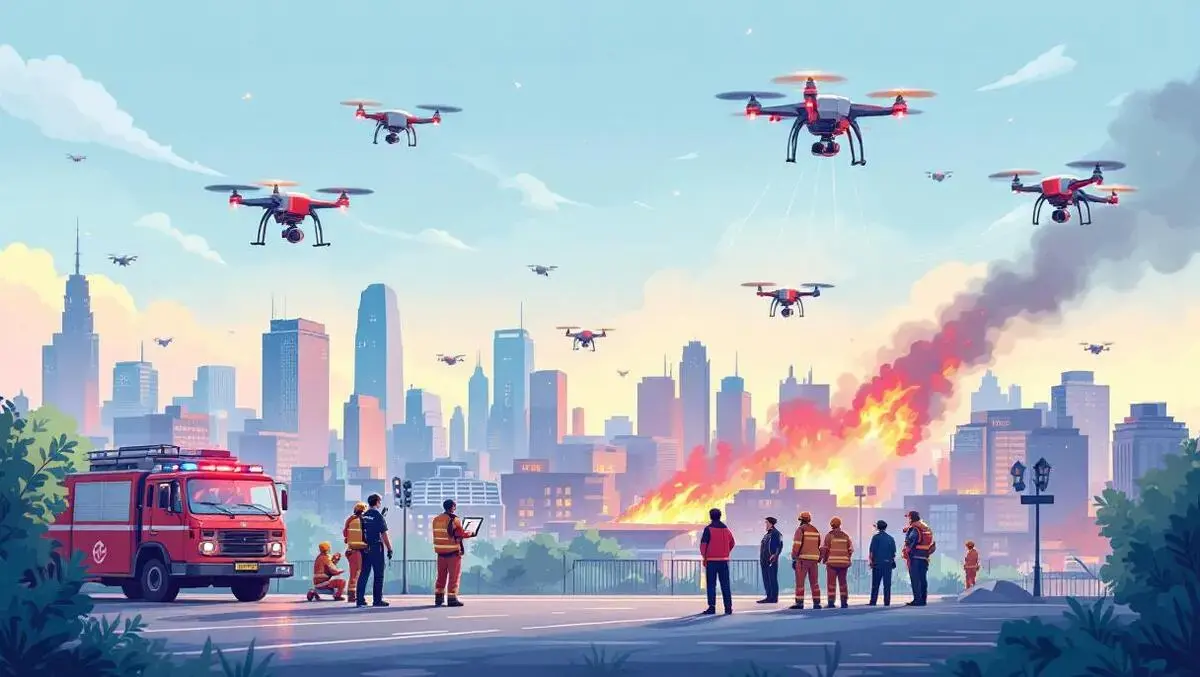
Public safety teams are using drones in policing, emergency services, search and rescue, fire response, surf lifesaving, transport, disaster relief, infrastructure assessment and aeromedical support. Aerial reconnaissance is now used to assess fire spread, monitor flood impacts and locate missing people in difficult terrain.
That broader use has also created operational strain. Agencies often work across multiple jurisdictions and alongside other emergency services and external partners, requiring different platforms, control systems and data sources to work together during incidents.
Getac says fragmented technology environments can isolate information in separate systems and slow decision-making when events are moving quickly. As a result, agencies are moving away from standalone tools and towards more integrated operating models.
"Agencies are shifting from standalone tools towards connected operational ecosystems, with an increasing focus on how technologies integrate and share information. The role of the ground control station (GCS) is evolving into a central point where data, platforms and personnel converge.
Public safety teams are dealing with increasingly dynamic situations where timely, accurate information is essential. The challenge is no longer just collecting data. It is bringing information together in a way that supports coordinated decision-making in real time," said Frank Baldrighi, Senior Business Development Manager, Australia and New Zealand at Getac.
Getac pointed to its CommandCore system as an example of that shift. It described the platform as an operational environment that can be adapted to different public safety settings, including mobile command vehicles, incident control points and portable field deployments.
Agencies can adjust deployment models, controls and interfaces, communications, and software and security settings to match specific workflows, including search and rescue missions, fireground mapping, flood assessment and broader emergency response activity.
Integration challenge
A central issue for public safety organisations is interoperability between existing tools. Drone fleets, sensors, payloads, communications networks, mapping tools, video feeds and operational software are often sourced from different providers and used by different teams.
Getac says a modular, vendor-agnostic design can help agencies connect those technologies within a single operating framework. In practice, that can involve local drone and payload specialists, emergency communications providers, geographic information system software suppliers, situational awareness platforms, mobile command vehicle integrators and public safety software vendors.
The goal is to build a control environment that fits local operating conditions and procurement rules while supporting multi-agency response models. That is particularly relevant for services that must maintain continuity between field operations and command functions during fast-changing incidents.
Mobility is another factor shaping system design. Public safety operations do not always follow a fixed command structure, so agencies may need to move between vehicle-based units and portable control points depending on an incident's location and scale.
Getac argues that this flexibility helps teams gather information, assess risk and allocate resources while maintaining a consistent operational picture. That is especially important in remote areas or disaster zones where infrastructure may be damaged.
Edge processing
Getac also highlighted the growing importance of edge-based processing in emergency response. During major incidents, connectivity can be weak, disrupted or unavailable, making it harder to send data back to central systems for analysis.
Processing information closer to where it is collected can help teams maintain situational awareness when network access is constrained. According to Getac, this allows responders to keep operating with access to current information even in difficult environments.
"In emergency response, delays in information flow can have real consequences. Systems must support continuous access to data and maintain performance in challenging environments so teams can act with confidence when it matters most," Baldrighi said.
Getac says public safety agencies are placing greater emphasis on systems that bring together people, platforms and information in a coordinated way. It argues that the ability to share information in real time across agencies is becoming more important as operations grow more complex and data-driven.
"Platforms that connect diverse technologies and public safety responders within a single operational framework will play an increasingly important role in time-critical, data-driven environments. The ability to maintain situational awareness, coordinate across agencies, and respond in real time is becoming central to effective public safety outcomes," Baldrighi said.